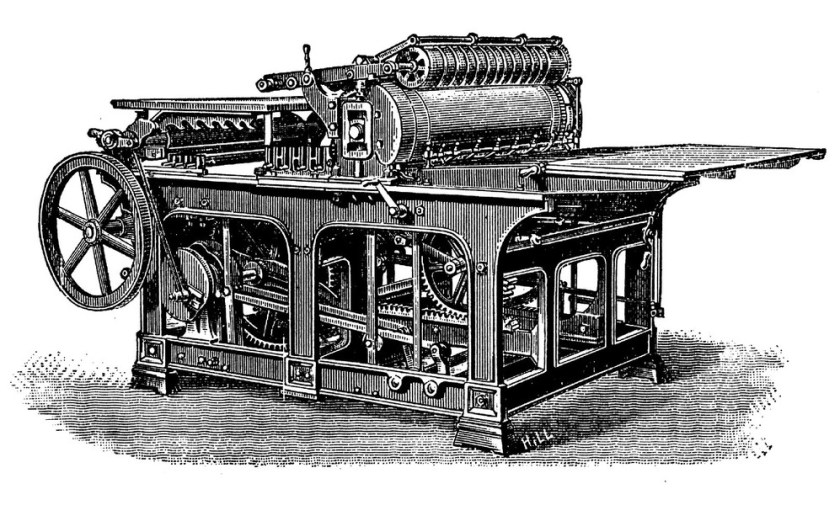
At one time, a career in the print industry was almost a licence to, well, print money. I remember back in the ’80s you couldn’t walk down your local high street without seeing at least one print shop of one form or another. And, if you didn’t want to get your fingers dirty, there was always Print Buying – providing a client with their ink on paper needs without the hassle of running a 5-colour SpeedMaster. As an aforementioned Print Buyer you could slap a hefty mark-up on jobs and your client would still be happy.
But, that was back in the ’80s.
The introduction of desktop publishing was hailed as a revolution in artwork production and, by the early ’90s, was in full swing, enabling a new breed of designer to produce digital files that could be sent by courier to a repro house for outputting to film and subsequently plates for a plethora of print machines. Getting a four-colour job in was a repro house’s dream – 200 quid for one set of plates was the going rate so, if you got magazine work, you were laughing, not to say extremely busy.
The advent of DTP was the nail in the coffin for traditional paste-up artists who, like me, had cut their teeth, not to mention fingertips, with a scalpel and Rotring technical pen. Workstations could be hooked up to imagesetters so that, instead of outputting galleys of type the old-fashioned way, fully laid up pages could be output ready for the plate-making process.
The natural follow-on was CTP – Computer-to-Plate – systems which worked the same way as an imagesetter but cut out the middle-man – sorry – the repro houses. Now, print companies that didn’t previously have in-house repro capability, could produce their own plates. Nail number two.
By the mid ’90s, print was still very much alive and kicking.
But something was lurking in the shadows. Something that, up until now, had only been reserved for large institutions with internal computer networks.
As mere mortals, if we wanted to send a file to someone, we could use an ISDN line. Superfast, well it was back then, at 96Kb/s – we could expect to send a 1Mb file in 20 minutes, if we were lucky.
But what was lurking in the shadows opened its beady eye and announced itself to the World – the birth of the Internet, or the World Wide Web as it was quaintly referred to back then. The rest is history as we all know. Where would we be without the Internet? No email, no websites – you wouldn’t be reading this article without it. But did anyone stop to think – what about print?
As time went on, people began to like this Internet thing and so it grew. Becoming ever more popular, it was the new kid on the block. Large corporations established a web presence, advertising themselves with punchy websites and even punchier graphics. But print was still popular. It was still in the corner of the playground with a modest crowd of mates. Companies still wanted their glossy brochures printed, their invoice books and business cards.
Fast forward a couple of decades, just enough to see a child grow up and go to school and college, and we see that print isn’t quite the crowd-puller it used to be.
IPEX, the International Print EXhibition, used to be a regular event in the printer’s calendar and if you were fortunate enough you may have gone to Drupa in Heidelberg, the founding city of the legendary presses. Print exhibitions were the Mecca for every printer in the world. Hall upon hall of exhibition centres were full of printing machines and equipment. I remember going to the NEC in Birmingham. Five, yes five, halls of international print manufacturers exhibiting everything from DTP to massive presses. Heidelberg showcased their automatic plate loading cassette system on a 5 colour SpeedMaster – accompanied by Tina Turner banging out ‘Simply the Best’! The last print show I attended recently occupied one hall at Excel and there wasn’t a litho press to be seen!
But the Internet has become a jealous, spoilt child – it sees something it wants and it grabs it with both hands. It coerces its users to abandon the old ways and traditions. The dream was for the ‘paperless office’ but did that dream take into account what happens to the mills that produce the paper and the (human)printers that print on that paper?
In the past ten years, I have seen as many printers crumble away just in my local area. But there has been no take-up for those that have survived. Where did all that print go? Has the charm of a glossy brochure faded? Have business cards really been replaced by digital contacts on smartphones? Paper invoices replaced by PDFs? As humans, have we really become a less tactile species?
I keep seeing headlines announcing that print is alive and well, but where is the evidence? Where has that print gone?
 GK Creative